
Author business insights
Getting published means you’ll have to deal with pesky business issues.
This book addresses those issues in plain language, not MBA double-talk, so you’ll learn how to deal with the issues that you’ll face as an author.
Related products
-
Creating Your First Novel
Are you writing your first book? Or are you thinking about writing it? Do you have any idea what you’re getting into? No? Let’s talk about it Most aspiring authors concentrate on writing the book to the exclusion of all else. However, the reality is that creating a book is a long-term, multi-phase project and writing it is only one facet of the project. The complete project involves five separate phases:- Planning the book
- Writing the book
- Publishing the book
- Marketing the book
- Author business issues
-
Beginner’s Guide To Creating Genuine Characters
Creating a fictional character that gabs the reader's attention is a difficult task The Beginner's Guide to Creating Genuine Characters makes the task much easier. Filled with information and examples from books and movies, this Beginner's Guide is targeted to writers who are just starting to write their first story. A story, whether it be a short story, a novel or a screenplay, is about the characters and their journey from the beginning of the story to the climax. Inexperienced fiction writers struggle with character development. To overcome their inexperience, they need guidance and examples and that is what this book is about: showing writers how to develop their characters. The ebook uses artificial intelligence to generate reports on what makes a character 'great.' It also uses AI to generate what makes specific characters from literature and movies 'great.' -
Creating Stories
-
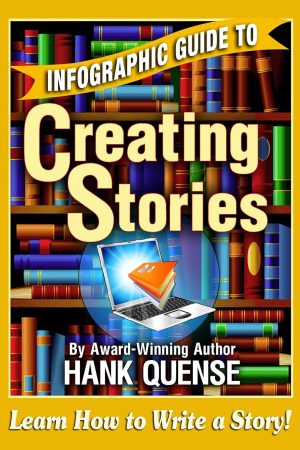
Infographic Guide to Creating Stories
Do you have a story struggling to come out? Do you know how to write it down? Or how to tell it?Writing a story involves weaving many elements together to create a singular tale. If you’re stumped on how to get started, you need this book: Infographic Guide to Creating Stories Hank Quense tells you how to create your story. He believes that stories come from the melding of three elements: getting ideas, story design and story-telling. Ideas have to come from the author. Infographic Guide to Creating Stories concentrates on the last two. The book concentrates on developing characters including such rarely discussed requirements such as a dominant reader emotion and the character's biography. Plots are also covered in depth and a number of graphics are included to illustrate complex points. Another topic discusses subplots and how to utilize them and how to nest them within the main plot. A separate chapter discusses the relationship between the plot and the emotional arcs. Other topics covered are: character arcs, scene design, point-of-view, writing voice and more.

There are no reviews yet.